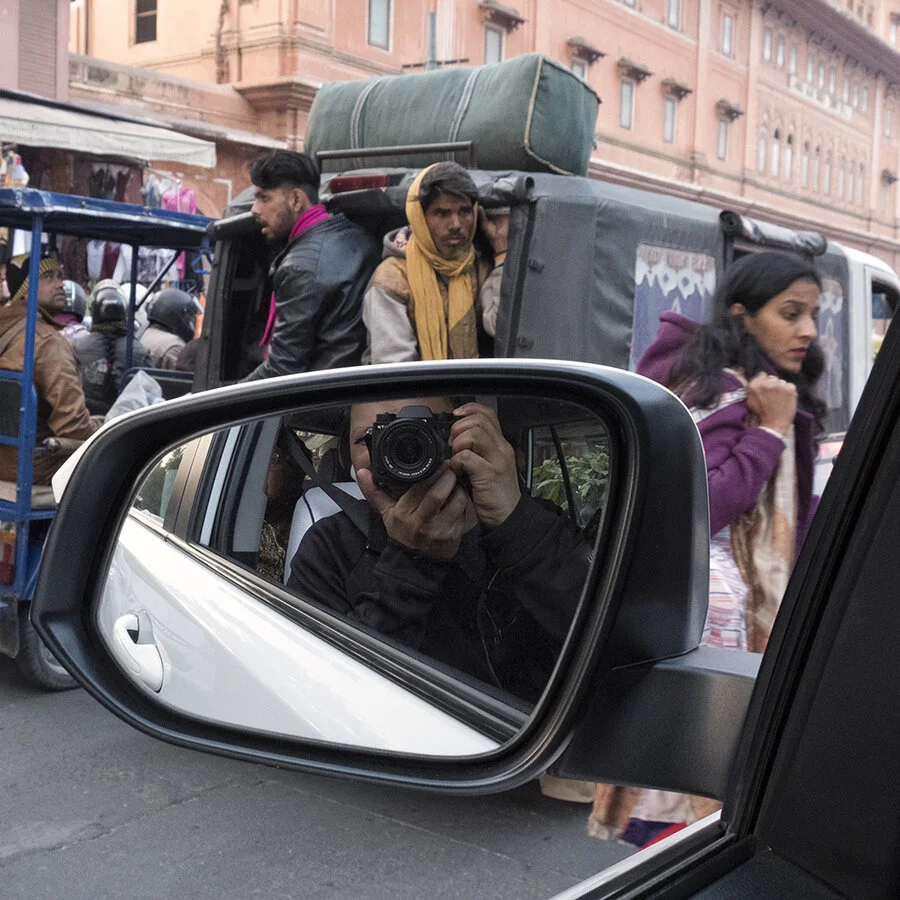
Artist Statement: The Observer’s Rhythm
Street photography is what I enjoy - and over twenty years, that’s meant a lot of different streets. Colfax Avenue in Denver, the alleys of El Raval in Barcelona, the red-brick walls of Bow Barracks in Kolkata. Every street has taught me a different way to look.
My mentor, the late Standish Lawder, used to say, “Every print is a test print.” He taught me the discipline of the craft at the no-longer-existing Denver Darkroom. That’s where I first fell in love with the slow, three-step magic of the chemicals. Standing over a developing tray, waiting for a shadow to emerge from the white - sometimes you’d get it, sometimes you wouldn’t. That sense of patient uncertainty never left me, even after I moved from film to digital.
As an observer, I don't believe in “hunting” for a perfect, staged moment. Instead, I believe that if I am mindfully present at a scene - just me and the camera - I can find the moment as it unfolds. I look for those brief but solid moments that stay quiet even when the city is chaotic.
Whether it is the ritual of a local barbershop or the high-tension embrace of a street tango, my goal is to honor the truth of the scene. I keep my digital process minimal, mostly because I don't want to mess with what was actually there. I often choose not to “clean up” the frame by removing onlookers or urban grit, because those elements are part of the street’s honesty.
When I use the digital darkroom, I use it as Standish taught me: to strip away the noise and pull the eye toward what I actually remember seeing. I might blur the periphery or deepen a shadow, but it isn’t a stylistic choice - it’s an honest one. That is simply how memory works. These are the rhythms I don’t want to lose..